

a behind the scenes look
What is the Dark Web?
Every financial institution has customer data, account credentials, payment cards, and checks circulating in a part of the Internet it can’t see. This is what that place actually is — what trades there, who runs it, and what it means for your institution.
The Internet’s Three Layers
The surface web is what search engines can see. Beneath it, the deep web holds everything behind logins and paywalls. At the bottom sits the dark web — anonymized networks where stolen financial data is traded. The deeper the layer, the fresher and more valuable the stolen data.
The Surface Web
Public and indexed — and usually stale by the time it lands here:
- Social media groups featuring scams and promo abuse
- Card numbers from years-old dumps
- Credentials from public breach compilations
The Deep Web
Private — behind logins and paywalls (~90% of the web). Fresher, but widely traded:
- Reused credentials being validated
- Card lists changing hands
- Breach data resold to many buyers
The Dark Web
Secret — anonymized and reached only on purpose. The freshest, highest-value data:
- Freshly stolen PII
- Live malware logs with active banking sessions
- New scam scripts before they launch
What does financial crime look like on the Dark Web?
These are not dumps of raw data. They are functioning storefronts — inventory, search filters, vendor ratings, escrow, and proof-of-possession. That structure is what makes a finding collected here confirmable rather than inferred, and it is why an alert can name the specific card, account, or check.
Automated Card Shop
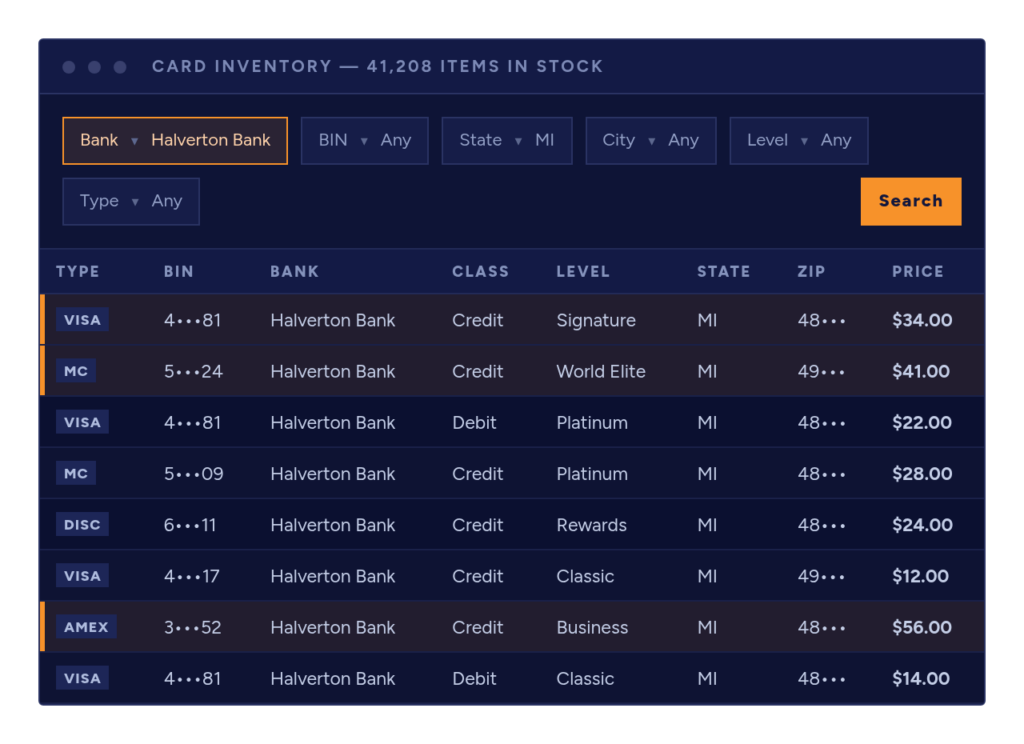
Targeting one institution is a dropdown. A fraduster filters by bank, BIN, state, and city. There is no need to guess which cards belong to you — the shop sorts that for them.
Class and level are disclosed up front, so higher-limit cards can be bought deliberately. The premium rows above are priced at three to four times a classic debit card for exactly that reason.
This is also what makes the finding confirmable. The listing itself carries the BIN, the class, and the geography — so a compromise can be matched to your portfolio rather than inferred from a breach.
Credential Listings
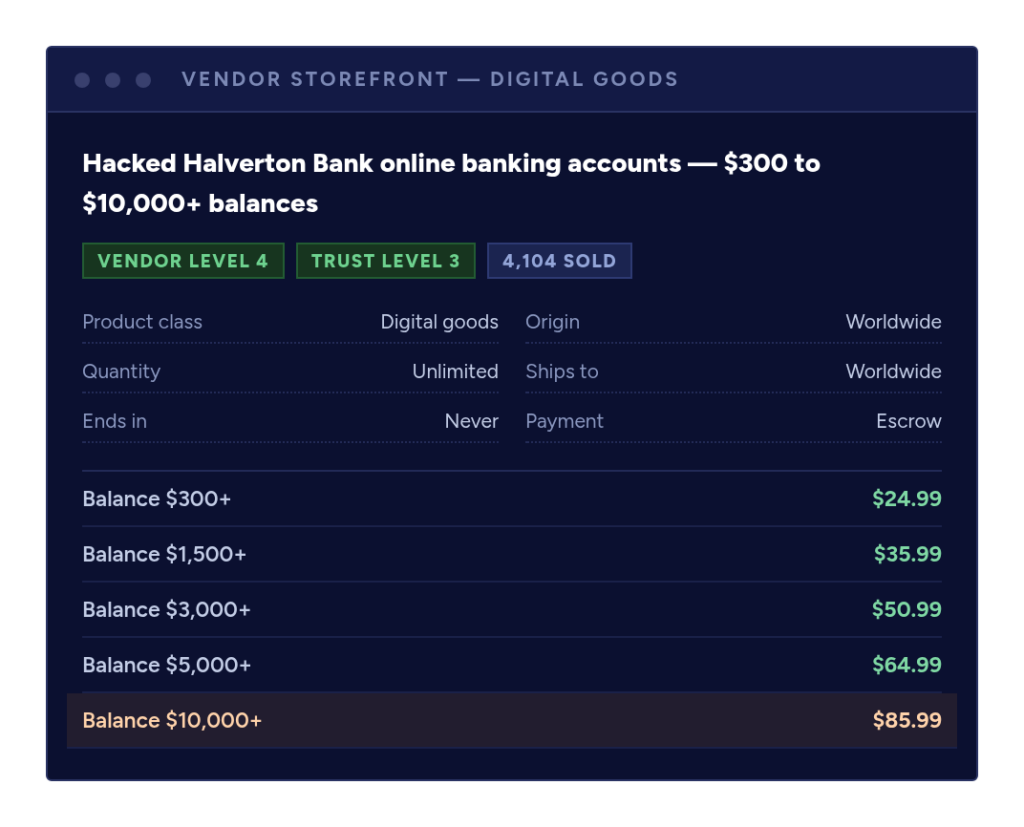
The institution is named, and balance is the price driver. Your highest-value customers are the most expensive line on the menu, which makes them the most actively hunted.
In addition to their credentials, the package may include additional credentials sensitive PII and additional (e.g., email) belonging to on the account holder By the time a credential is listed it already works — the vendor has tested it. Detection at login is downstream of a sale that has already happened.
Stolen Check Reseller
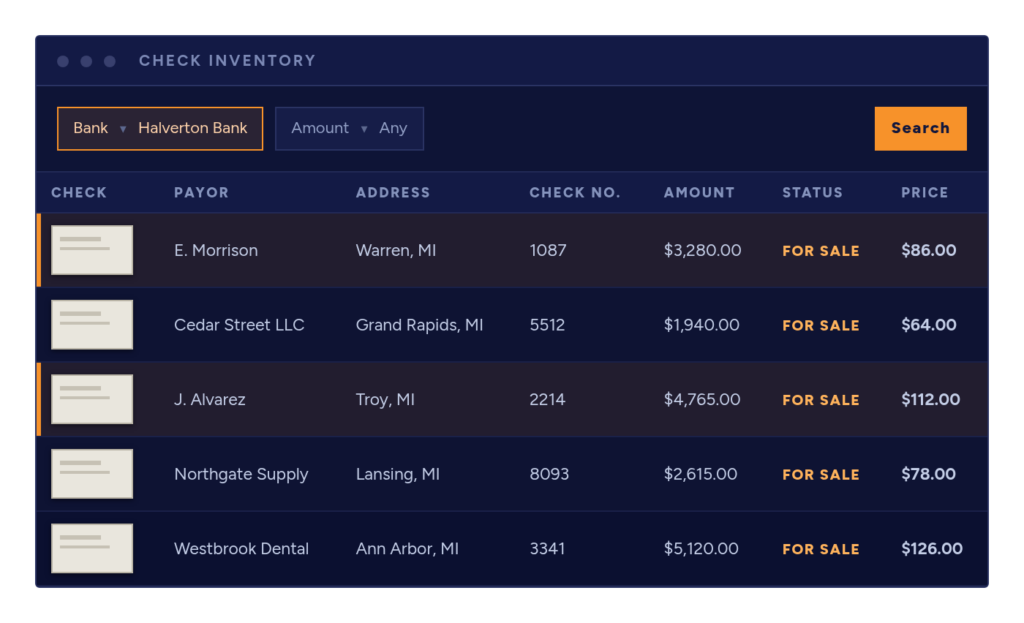
Each check is offered by the accountholder’s name, the amount, and a price, days or weeks before it ever reaches a teller line. Stolen, washed, altered, and counterfeit checks move through a professionalized underground where sellers trade balance information and alteration techniques in real time — a mature supply chain, not a one-off theft.
Image-based review at presentment and consortium data see the item for the first time on the day it clears, and by then it has often already been tested somewhere else. Positive Pay is a strong control, but it only helps if you know which check to stop. Knowing the specific payor, amount, and check number ahead of the deposit is what makes that control precise instead of reactive — time to place a stop payment, apply a hold, or close and reissue the account before the loss, not after.
These are illustrations use fictitious information with institution names are placeholders and card, account, and routing details are redacted or invented. The structure — the filters, the vendor ratings, the escrow, the balance-tiered pricing, the proof-of-possession convention — is as it appears in the marketplaces Q6 monitors.
Why it matters for financial institutions
The fraud you fight next week is underground today. Here’s how the most common attacks begin there — and where Q6’s early warning changes the outcome.
Account takeover
Stolen credentials, trusted devices. Malware on a customer’s device captures banking credentials, cookies, and session artifacts. Criminals log in from the customer’s own trusted device — past geolocation, fingerprinting, and some MFA.
With Q6: flag before first login. Those credentials surface in malware exfil logs, often before the first login attempt — so you flag the compromised account and step up controls.
Check fraud
Sold before deposited. Stolen, washed, synthetic, and altered checks are brokered in encrypted channels days or weeks before they’re presented. Teller-line image detection never sees it coming.
With Q6: ~7 days lead time. Act early with Positive Pay, stop payments, or account closure and replacement — before the deposit attempt.
Payment card compromise
Carding markets & common points of compromise. Card data from skimmers, malware, and merchant breaches is bundled and sold in carding markets, long before fraudulent charges post.
With Q6: reissue the right cards. Confirmed compromised cards plus the common point of compromise behind them — so you reissue or monitor the right accounts, not all of them.
Social engineering & scams
Beta-tested in private. Vishing, smishing, and BEC scripts and impersonation themes are written and tested in invite-only communities before they’re deployed against your customers and staff.
With Q6: warn before the wave. Emerging tactics caught early, so you can warn customers and prepare frontline teams before the campaign hits.
Fraud tools & services
One connected ecosystem. Kits, malware, mule networks, and playbooks for defeating your specific controls change hands across the same forums, channels, and markets.
With Q6: stay ahead of tactics. Intelligence briefings and reports on the newest tactics, so your program adapts before the most aggressive fraudsters arrive.
Anyone can see the surface. Reaching the bottom takes analysts, not crawlers.
Most “dark web monitoring” never goes far below the surface — it watches public sites and resells breach data that’s already everywhere. The highest-value intelligence sits behind doors that open only for trusted, vetted members. No crawler reaches it. No breach feed will ever contain it.
Technology alone doesn’t get you inside a private forum, an invite-only marketplace, or a criminal’s Telegram channel. That takes people — with established underground personas, relationships built over years, and the languages of the regions where financial crime originates.
That’s the difference between monitoring the Dark Web and actually working in it on behalf of financial institutions.
The analysts behind every alert
- 100+ years of combined threat-intelligence experience on Q6’s dedicated team.
- Established personas — underground identities and reputations held across closed communities.
- Native languages — working threats in the languages the criminal communities actually trade in.
- Fraud-first leadership — careers in financial-crime investigation, so alerts map to fraud work, not generic cyber risk.
Standing coverage across Eurasia · LATAM · Europe · China · U.S.
We’re already inside. See what we’ve found on your institution.
Our analysts are inside the criminal underground right now — capturing confirmed compromises tied to your institution before they become fraud.