

The Interchange Engine: How Actors Turn Loan Payments Into Reward Factories
The “Game”: How the Scheme Works
Unlike traditional fraud involving account takeover or theft, this scheme is a calculated misuse of payment rails. The goal isn’t to pay off a loan; the goal is to move money in circles to farm points.
The Setup: Actors procure high-reward fintech debit cards from niche issuers, targeting programs that offer cashback on transactions usually excluded by legacy banks. To fuel the operation, they draw down on a Line of Credit (such as a home-equity-line of credit/HELOC) or personal loan, using these funds to load the debit card balance.
The Payoff: Using the now-funded debit card, they execute a loan repayment back to the originating line of credit.
The Loop: Because the objective is points rather than genuine debt reduction, the cycle effectively spins in place. To sustain it, the actor immediately redraws the payment amount from the line of credit, transfers it back to the debit card, and repeats the process indefinitely.
The Cost: This happens with high velocity – often multiple times a day – forcing the financial institution to pay interchange fees on every single transaction.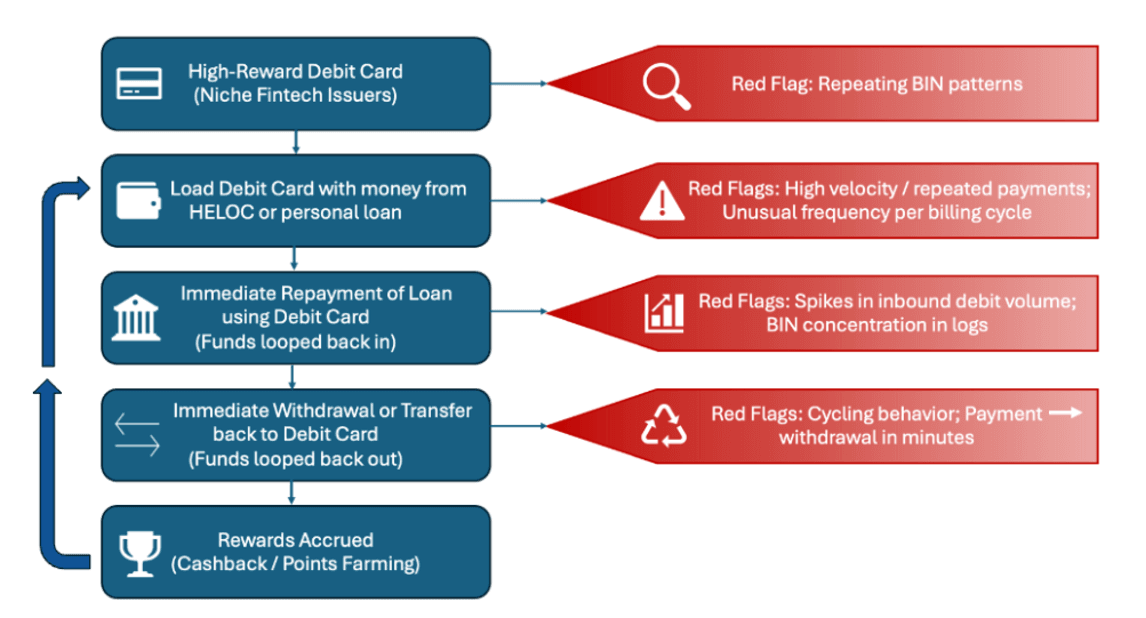 The “Interchange Engine” cycle showing how funds are looped to generate rewards, highlighting the “Red Flags” visible at each stage of the transaction.
Impact on Financial Institutions
This is not a victimless arbitrage. The impact on the institution is twofold:
Direct Financial Loss: FIs are paying interchange fees on incoming debit transactions that have no economic value to the bank.
Operational Abuse: The high-velocity volume distorts transaction logs, skewing data and triggering false positives in fraud monitoring systems that are looking for real threats.
Detection: What to Look For
Security and Fraud teams should tune their monitoring for these three specific indicators:
Repeating BIN Patterns: Look for a disproportionate volume of inbound payments coming from a single BIN or a small cluster of BINs, specifically those not associated with major legacy banks.
High Velocity: Flag accounts making multiple loan payments in rapid succession or at an unusual frequency within a single billing cycle.
The “Cycling” Pattern: Watch for payments that are immediately followed by withdrawals or transfers of similar amounts, suggesting the funds are being looped purely for spend volume.
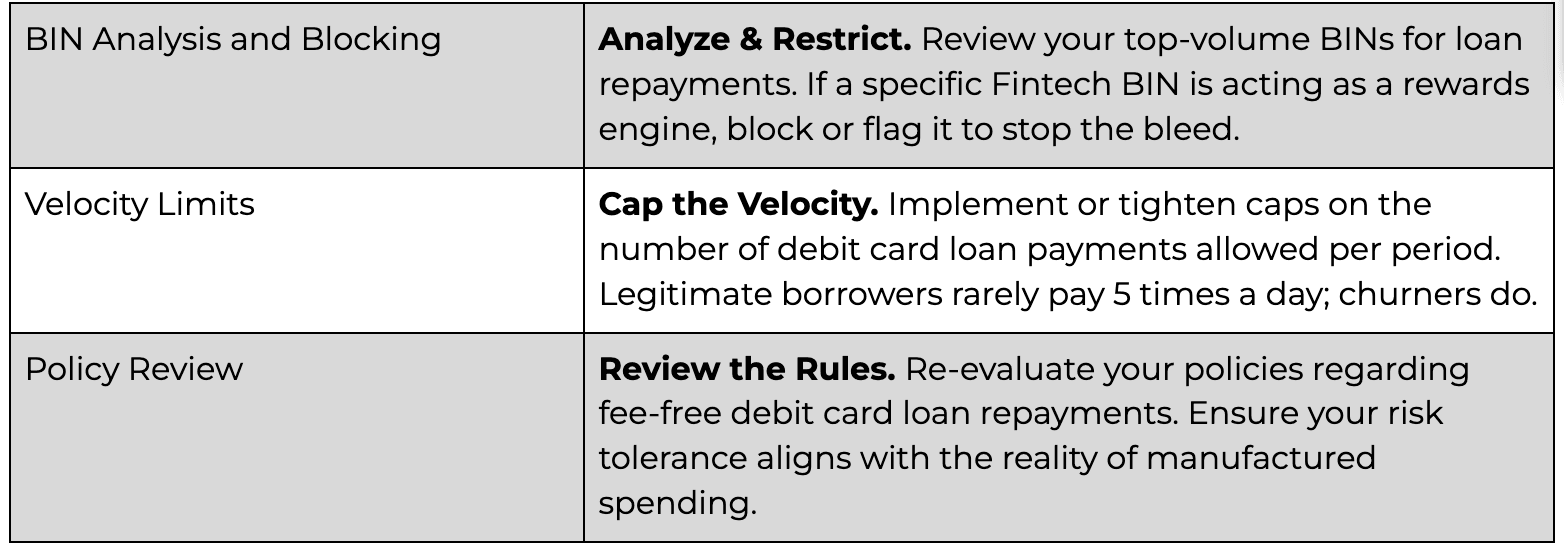
Best Practices for Mitigation
To stop subsidizing these rewards points, we recommend the following defensive measures:
Don’t forget
to Visit