
Stolen Treasures, Dirty Money and NFTs

ART, BUT MAKE IT CRIMINAL
- Money laundering through art provides bad actors with anonymity and a global market that lacks regulations and oversight. This creates an ideal environment for washing large amounts of money and concealing its origins.
- By purchasing fine art and antiquities through third parties, reselling the items multiple times to create an appearance of legitimate transactions, and finally selling the artwork to a genuine buyer at a higher price, criminals can effectively launder money.1 Terrorist organizations such as the Islamic State have historically used looted artifacts and the buying and selling of art as a means of financing their activities.2
- Over the past few years, money laundering involving non-fungible tokens, or NFT’s, has come to the forefront. Similar to traditional art money laundering, the NFT market allows individuals to hide their identities and easily alter the cost of their digital assets to launder funds.
FRAMED FOR FRAUD
Art money laundering is the process of buying and selling fine art or ancient artifacts to conceal the origins of illicitly obtained funds. This type of money laundering is highly attractive as deals are typically handled by intermediaries, which provides anonymity. Additionally, the art market provides a framework for high-value transactions and the ability to wash large amounts of money.3
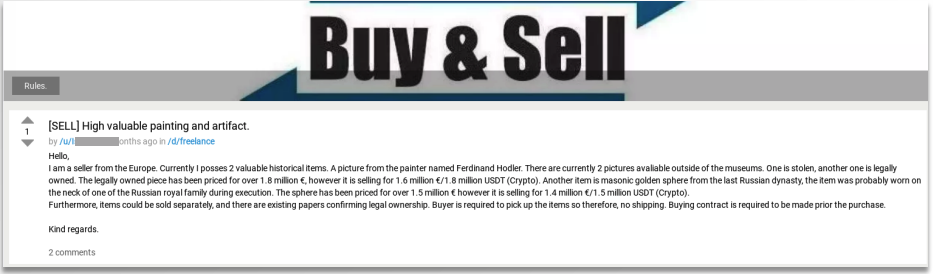
This global market also lacks transparency and regulations.4 While international regulations exist, countries vary in their adoption and enforcement of these practices. Most jurisdictions of the art market do not fall under specific anti-money laundering regulations. While the US Anti-Money Laundering Act of 2020 brought antiquities dealers under the same framework as financial institutions, implementation is still pending the rulemaking process.5
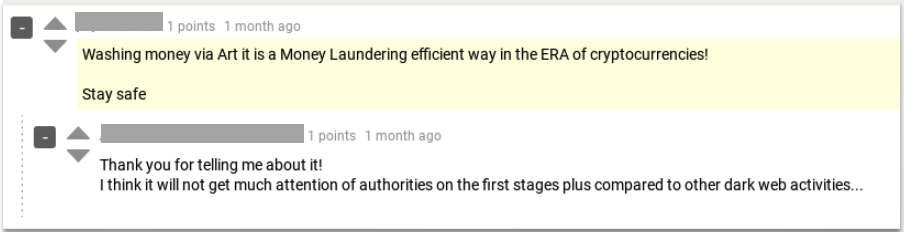
Terrorist groups and transnational criminal organizations have historically utilized art money laundering as a source of financing. The Islamic State was reported to have sold stolen antiquities on the dark web using Bitcoin and smuggling these pieces throughout the region and into Europe.6
The excavation, looting, and smuggling of cultural artifacts has remained a popular method for other terrorist groups in the Middle East and Africa.7 More recently, a financier for the U.S.-designated foreign terrorist organization, Hezbollah, was charged with multiple crimes for funding the organization with art and diamond transactions. Previously sanctioned by the U.S., the financier used anonymous shell companies to purchase and export over $200 million in art and diamonds.8 9
Non-fungible tokens (NFTs) are digital assets stored on the blockchain and have in recent years become another popular tool for money laundering. NFTs are distinctly different from cryptocurrency as these tokens represent the ownership of artwork, videos, etc. NFTs and other digital arts fall under the US Department of Treasury’s definition of “art”. Cryptocurrency is the means for purchasing NFTs.10
The NFT trade market allows users to remain undetectable and the cost of NFTs can be easily altered, increasing the feasibility of money laundering.11
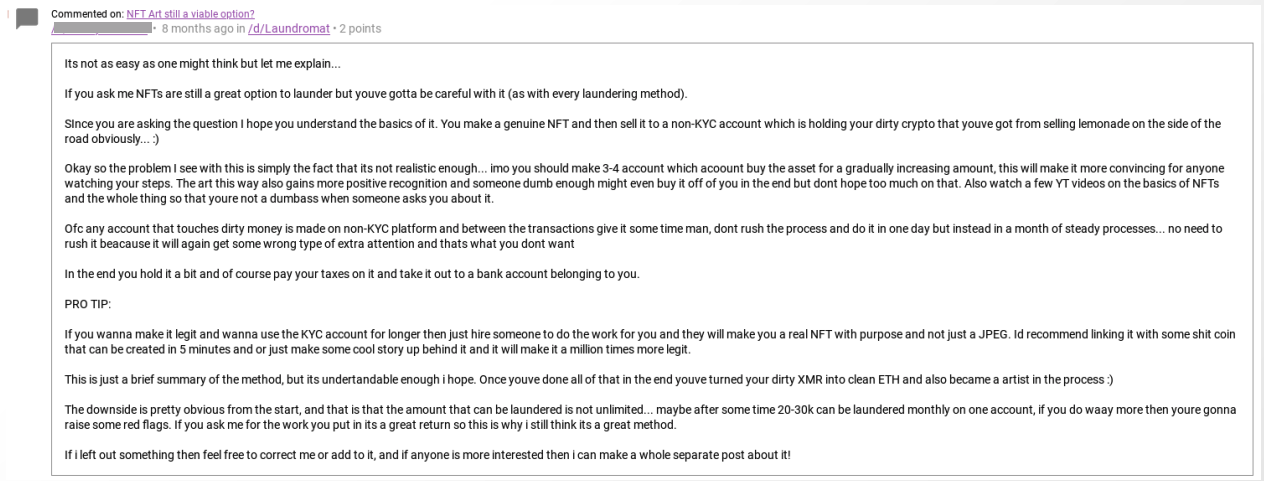
- Wash trading: continuous purchasing and selling of NFTs with different accounts helps increase an NFTs’ cost to make illicit funds appear legitimate.12
- Overpaying: purchasing an NFT at an extremely high price to transfer illegitimate funds to another party under the appearance of a legitimate transaction.13
- Selling Self-Created NFTs to Oneself or Partners: selling self-made NFTs at inflated prices gives the appearance of genuine trading, but over time it is difficult to trace the transactions.14

- Greater Due Diligence for NFT-Related Transactions: Improving due diligence for new customers can help recognize NFT money laundering schemes. Customers with a history of large or high-risk NFT transactions should be questioned on their knowledge of these tokens and the funds being used to purchase them.
- Blockchain Analytics: Integrate blockchain analytics tools into existing AML and KYC protocols to follow transactions, detect high-risk wallets, and identify patterns that may indicate money laundering, including unusually large NFT purchases and successive transfers of funds followed quickly by NFT purchases.
- Employee Training and Awareness: Employees should be educated on the basics of NFTs, blockchain technology, and similar types of money laundering. Regular training and knowledge of these topics can help financial institutions recognize and mitigate this activity.
2https://www.mdpi.com/2076-0752/7/2/12#B46-arts-07-00012
3https://alessa.com/blog/art-money-laundering-explained/
4Ibid
5https://financialcrimeacademy.org/art-market-and-aml-regulations/
6https://www.mdpi.com/2076-0752/7/2/12#B46-arts-07-00012
7https://www.fatf-gafi.org/content/dam/fatf-gafi/reports/Money-Laundering-Terrorist-Financing-Art-Antiquities-Market.pdf.coredownload.pdf
8https://www.prospect-journal.org/articles/modernartisfundingterrorism
9https://www.justice.gov/archives/opa/pr/ofac-designated-hezbollah-financier-and-eight-associates-charged-multiple-crimes-arising-out
10https://amlwatcher.com/blog/integration-of-money-laundering-in-art-and-nft-markets/
11Ibid
12Ibid
13https://www.lexisnexis.com/blogs/gb/b/compliance-risk-due-diligence/posts/money-laundering-with-nfts?srsltid=AfmBOorJ6b8pd_LE9Tk9g42AlliaHcNqjCEaMA5ED_5Yz568Hhhd8-go
14Ibid